


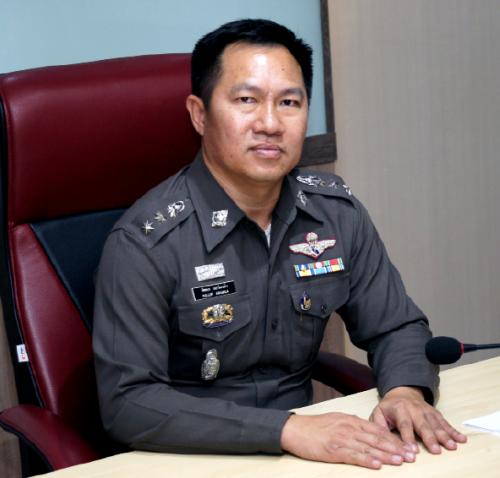
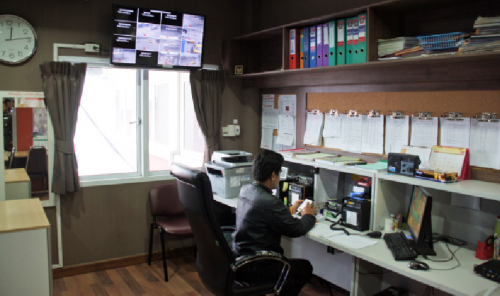
Pol Col Pullop showed me around Bang Phli station’s modern Traffic Control Centre. “Dispatchers are on duty around the clock and upon receiving a call they radio to one of our patrol teams, who promptly proceed to the scene. The control centre is equipped with 16 colour monitors that receive feeds from strategically placed CCTV cameras and show how traffic is flowing in the area. Everything is recorded. The center also has nine large television screens mounted on the wall and tuned to different Thai TV news channels.”
He then explained the procedure for patrols sent to traffic accidents: “After arriving at the scene of an accident, the patrolmen take photos of the crash site, draw a map of the scene and talk to witnesses. The same police team must make a report back at the station and contact the families of victims. Then they go to the hospital to see the victims and help make identifications if there are deaths. In some cases vehicles are impounded for forensic examination. A lot of documents have to be written up and the patrolmen are assisted in this by our administrative personnel. Sometimes the case goes to the prosecutor and to court and the police who took the call must also appear in court.
“The number of cases that must be investigated differs from station to station, of course,” said the superintendent. “In a relatively quiet district it might be 500 per year, while a district in Pattaya might see 5,000. We must respond to about 2,000 cases per year and around five serious cases every day. Fifty percent of all cases we handle involve narcotics, especially methamphetamine tablets (yaba) and crystal methamphetamine (‘ice’). The second most common problem is fighting. These involve mainly migrant workers from neighbouring countries who have had too much to drink. These situations are lethal sometimes.
“Most nights we receive two, three or even more calls about migrant workers causing a disturbance to our emergency 191 and Bang Phli police station number with requests for assistance. There’s no problem with communication in these situations. Most migrant workers can speak some English and so can we. We usually have enough manpower to attend to all emergencies but sometimes they pile up and people who need help have to wait,” said Pol Col Pullop, adding that the third most common problem is theft and the fourth is serious traffic accidents.
One of the station’s young police officers explained that after graduating from the Royal Police Cadet Academy he was attached to another police station in Bangkok before being transferred to Bang Phli about a year ago. Asked why he joined the RTP, he answered: “I want to serve my people and my country.” He insisted that he won’t accept bribes from anyone, no matter how much money is offered, and he follows the law no matter how big or influential any suspect thinks they are. “If someone breaks the law I will arrest them, period.”
The young officer said that his uniform and accessories cost him altogether about 4,000 baht. “The silver stars on my shoulder cost me 250 baht each, and I have four. Guns are expensive and some policemen don’t feel they can afford to buy a good one, but my philosophy is that this is a dangerous occupation and a reliable handgun is a necessity.
However, those attached to the administrative section don’t necessarily need a gun.”
He echoed his superior’s comments about problems with migrant workers adding to their workload. “We have tens of thousands of workers from neighbouring countries, especially Myanmar and Cambodia, working in factories in and around Bang Phli. They are willing to work for 300 baht a day or less and some are undocumented. These enter Thailand illegally. Some are smuggled through Mae Sot or Kanchanaburi. Some are registered to work in a certain job but they do some other kind of work. This is also illegal.
“When migrant workers fight we are called to break them up and sometimes we make arrests, and sometimes when we arrive there are dead bodies that must be taken care of. In my experience not many migrant workers take narcotics, maybe because they can’t afford it. They prefer to drink alcohol.”
Bang Phli has cells for prisoners who can be kept there for up to 48 hours. “After that we send the suspect to the court in Samut Prakan. In a big case, the court can order detention up to 84 days before a trial. We have to bring suspects to the court whenever their cases are being considered. We have a prison car with a police driver and guards who accompany suspects to the criminal court, or juvenile court if the suspect is under 18 years.”
One policeman asked what foreigners in Thailand think about the police. When told of the general perception, none of the officers seemed at all surprised. A police colonel in charge of investigations asked for this message to be passed on: “All policemen and policewomen assigned to Bang Phli police station would like to tell foreigners and the Thai public that we are working very hard to ensure safety for the public. I am sure that this is the case all over Thailand.
“Often when we are sleeping or trying to relax a call comes in and we have to go to work.”
One young policeman remarked on an apparent paradox: “It’s funny, you know. The public always criticizes us, the job is dangerous, the hours are long and the rewards are small, but whenever there’s a recruiting program there are always more than 10,000 applicants wanting to join us.’
The BigChilli wishes to thank Police Colonel Dr Pullop Aramhla, Superintendent of the Bang Phli police station, and several officers under his command for providing insight into their daily lives.