


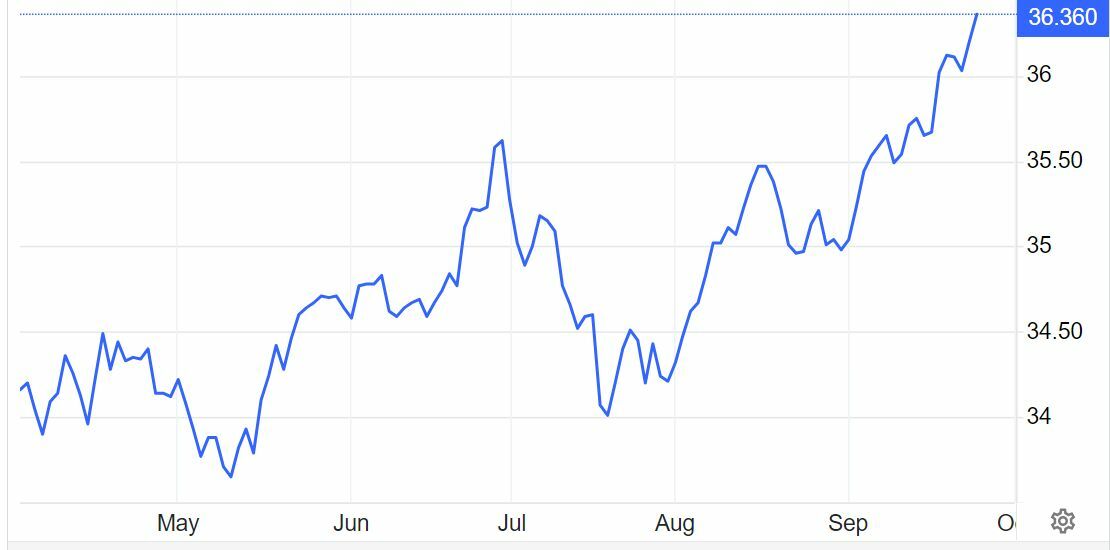
Asian currencies faced a decline today, with the Thai baht and Indonesian rupiah being the most affected by the losses. This was primarily due to the increasing strength of the US dollar, supported by strong economic indicators and concerns about inflation from the Federal Reserve. These factors have pushed US bond yields to their highest level in 16 years.
The Thai baht experienced a drop of up to 0.8%, trading at 36.34 against the dollar offshore, marking its lowest point since November 10, 2022. Meanwhile, the Indonesian rupiah fell by as much as 0.6%, marking its most significant decline in eight months.
Edi Susianto, a senior official, mentioned that the central bank of Indonesia has been actively intervening in the foreign exchange market to maintain stability while closely monitoring the fluctuations in Asian currencies.
The 10-year Thai government bond yield reached 3.26%, its highest level since May 2022. Similarly, Indonesian 10-year benchmark yields also rose to their highest point since March 30, standing at 6.86%.
Investor confidence in the baht has been dampened by ongoing fund outflows, driven by wider interest rate differentials and a recent surge in oil prices. The latter could potentially lead to increased inflationary pressures in Thailand, as it is a net oil importer.
The focus has now shifted to the Bank of Thailand’s upcoming policy decision, which is expected to maintain the key policy interest rate at 2.25%, according to analysts polled by Reuters.
Increased government expenditure aimed at revitalizing the struggling economy has raised concerns about potential budgetary consequences, further undermining investor confidence, as noted by Christopher Wong, a foreign exchange strategist at OCBC.
The outflows from funds are not limited to Thailand alone and are affecting a significant portion of the region. This is primarily due to the prevailing belief that the Federal Reserve will maintain higher interest rates for an extended period.
In August, Singapore’s industrial production declined for the 11th consecutive month, largely due to a slump in the electronics industry, causing the Singapore dollar to depreciate by 0.2%.
The US dollar index reached its highest point since November 2022, standing at 106.1, following hawkish statements from the Fed and the expansion of the budget deficit through borrowing, which resulted in a more than 45 basis point increase in the 10-year US Treasury yield in September, surpassing the 4.5% mark for the first time since 2007.
DBS analysts have acknowledged the challenges in the current financial landscape, stating that “the combination of a strong dollar and Asian central banks generally lagging behind their emerging market counterparts in raising rates makes the situation extremely challenging for Asian currency rates at the moment.”

